
Galungan is one of Bali’s most sacred and vibrant festivals – a Balinese Hindu celebration of the victory of good (dharma) over evil (adharma) and a time when the island’s ancestral spirits return to visit their families. Celebrated every 210 days according to the traditional pawukon calendar (roughly twice a year in our Gregorian calendar), Galungan is a ten-day holiday period that sees the entire island come alive with ritual and devotion. The festival culminates on the tenth day with Kuningan, when the ancestral spirits depart back to the heavens amid final prayers and offerings. In the hierarchy of Balinese festivals, Galungan is immensely important – often regarded as second only to Nyepi (the day of silence) in significance – and offers visitors a deeply inspiring glimpse into Bali’s living Hindu culture beyond the usual beach and resort scenes.
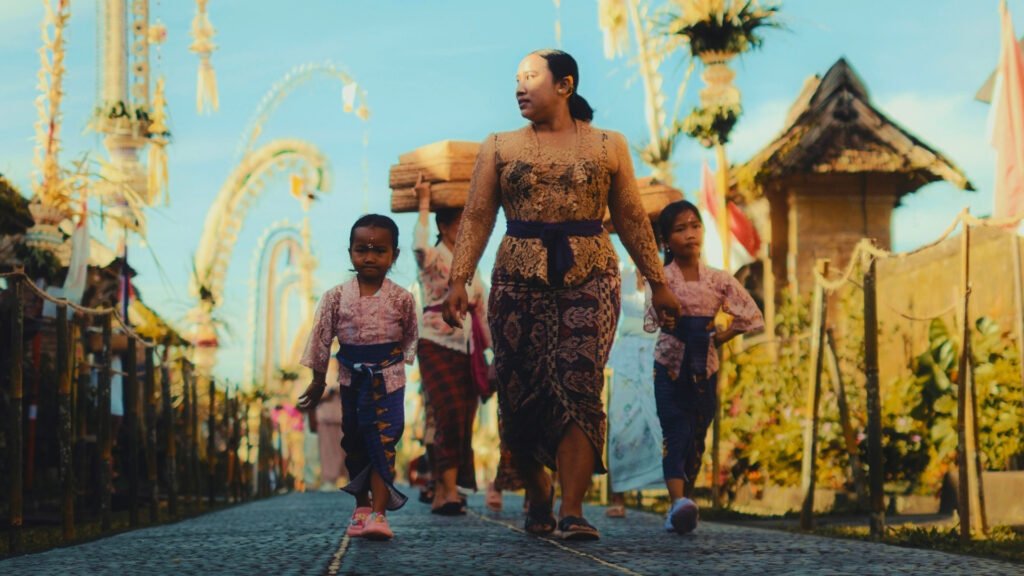
During Galungan, Bali is at its most enchanting. In the days leading up to the festival, villages and towns transform: tall penjor poles made of bamboo and lavishly decorated with young coconut leaves, fruits, rice, and flowers spring up in front of every household and business, lining the roads in elegant arches. These beautifully adorned penjor are the most iconic symbol of Galungan. They represent the cosmic Mount Agung (Bali’s holiest mountain) and the dragon Naga Basuki that safeguards the earth; they are essentially offerings of gratitude to the gods for nature’s bounty. Driving or walking through Bali’s streets at this time is unforgettable.
Galungan’s spiritual significance is deeply rooted in Balinese mythology and history. According to legend, Galungan commemorates an ancient victory of the Balinese gods led by Lord Indra over the forces of chaos embodied by King Mayadenawa, a powerful but impious ruler who denied the gods. In the epic tale, Mayadenawa’s defeat restored balance and allowed dharma (virtue) to prevail, with a sacred spring (Tirta Empul, near Ubud) miraculously created during the battle – a site still revered today. Historically, Galungan has been observed in Bali for well over a millennium: the earliest known record of its celebration dates back to 882 CE, inscribed in Balinese chronicles (lontar manuscripts). There was even a time in Bali’s history when Galungan was paused for 25 years during a period of strife in the 1700s, only to be joyfully reinstated by a later king who believed its absence had upset the island’s spiritual balance. This rich historical legacy gives Galungan a special gravitas – when the Balinese celebrate it today, they are consciously carrying on an ancient tradition, reinforcing a continuum that connects the island’s present to its storied past.
The rituals of Galungan unfold over a series of days, each with its own purpose and meaning, creating a build-up of spiritual energy that peaks on Galungan Day. The preparations begin several days out:
- Penyekeban (3 days before Galungan): Families start preparing food and ripening fruits for offerings. Green bananas are stored in clay pots to hasten their ripening. This day signifies “covering/closing” – symbolically, people begin to curb worldly desires and focus inward, preparing themselves spiritually.
- Penyajaan or Penyajahan (2 days before): A day for making jaja – traditional fried rice cakes and sweets that will be used in offerings. It’s a time of joy and togetherness in the kitchen, but also of mental preparation.
- Penampahan (1 day before Galungan): Known as Galungan Eve, this is the day of feasting and final prep. Many Balinese will sacrifice a pig or chickens early in the morning to prepare classic dishes like lawar (spiced minced meat salad) and satay for the family feast. It’s also when each household raises their penjor by the gate, transforming the streetscape. The act of slaughtering offerings on this day is rich in symbolism: it represents vanquishing the negative tendencies (often personified as demonic spirits) to ensure only purity enters the Galungan day. By sundown, homes are fragrant with spices and incense, penjor line the roads, and a calm, devout atmosphere descends – the stage is set for Galungan.
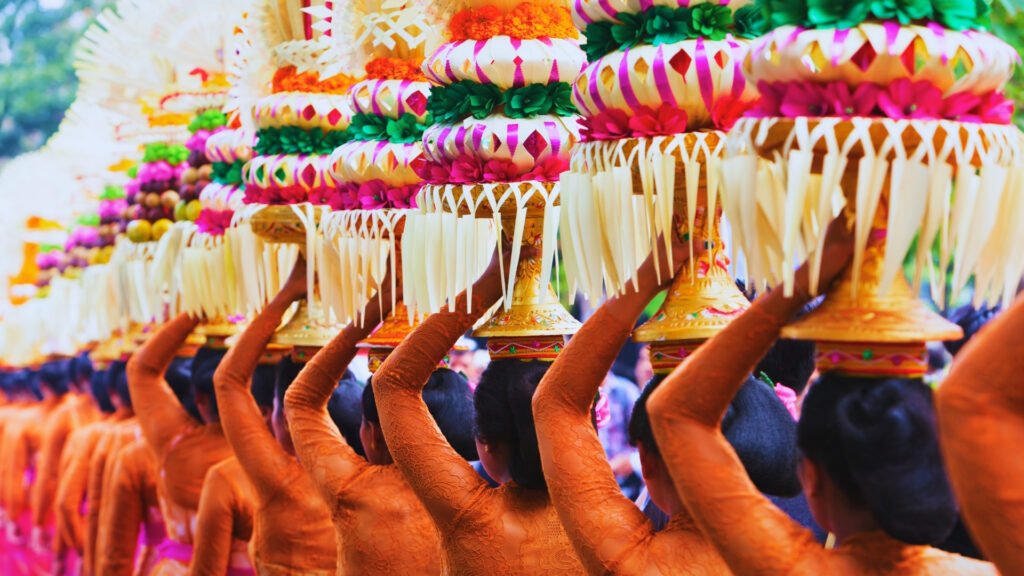
Galungan Day, which always falls on a Wednesday, is the pinnacle. At dawn, the entire island is already abuzz. Balinese Hindus put on their finest traditional attire and families gather at their ancestral temples and local village temples to pray together. All the hard work of preparations culminates in this day’s offerings: beautifully arranged towers of fruit and flowers, trays of woven palm-leaf offerings, and lit sticks of sandalwood incense are presented at temple shrines and household shrines, giving thanks to the divine and welcoming the visiting ancestral souls. It’s believed that during Galungan, the gods and the pitara (ancestor spirits) descend to Earth, so the prayers and offerings are exceptionally reverent and joyful – it’s like a grand spiritual family reunion. In every Balinese home compound, one can find a dedicated temple structure; on Galungan, these family temples become the focal point as they are festooned with flowers and offerings, transforming into gateways for ancestral spirits to bless the household. The feeling of Galungan morning is often described as magical: you’ll hear cheerful gamelan music and chanting from distant temples, smell incense and flower petals everywhere, and see whole communities moving in procession to their temples, balancing offering gifts on their heads.
The day after Galungan, Thursday, is called Manis Galungan (Sweet Galungan). Having fulfilled their religious duties, families treat this day as a time for relaxation, visiting relatives and neighbors, and enjoying the food and sweets prepared earlier. It’s akin to a holiday open house. Balinese people might go on leisure outings, and children are off school. You’ll find the roads busier than usual with local families on outings (so plan any travel accordingly), and you might be offered traditional snacks if you happen to visit a Balinese friend’s home. The entire Galungan to Kuningan period (10 days) is considered special; during this time, many Balinese also perform ngelawang – a form of exorcistic dance to ward off evil spirits. Often troupes of children carry a Barong (the mythical lion-like creature) from house to house, dancing and spreading blessings in exchange for small donations. As a visitor, if you see a Barong dance popping up in the street, know that it’s likely part of these Galungan traditions (feel free to watch, and giving a small tip is appreciated as you’re also considered to receive the blessing). Throughout the week, Balinese Hindus continue to pray, make offerings, and uphold an atmosphere of gratitude and togetherness, until the festivities conclude with Kuningan.
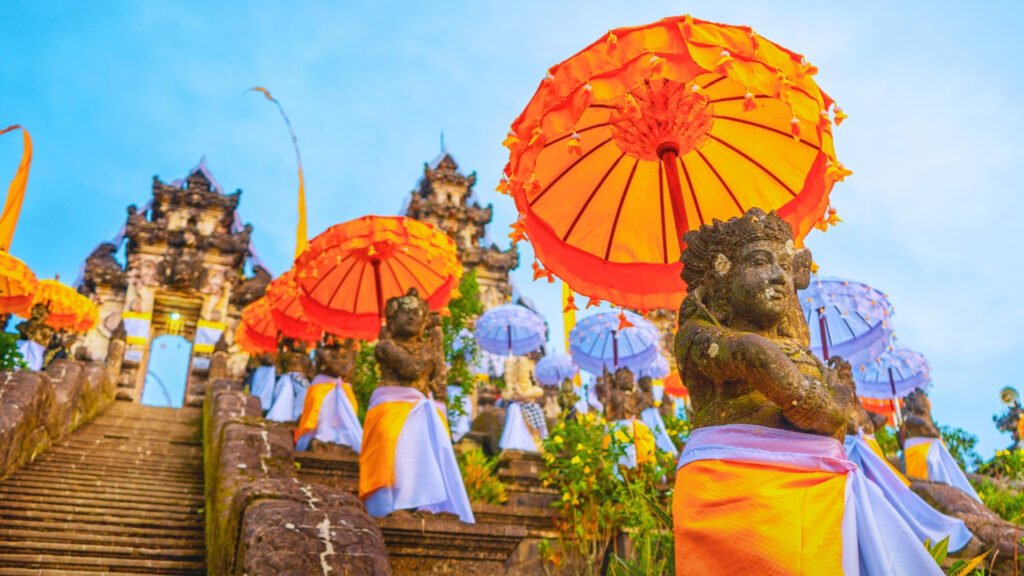
Kuningan, the final day of the Galungan cycle, falls on the second Saturday after Galungan (10 days later). It is a more solemn holiday in which the Balinese bid farewell to the visiting spirits. Special offerings are made early in the morning – notably yellow rice (nasi kuning, from which Kuningan gets its name) placed in small woven bowls along with items like turmeric, symbolizing prosperity. Families attend temple once more, often donning bright yellow or white garments to mark the the day. All rituals on Kuningan must be completed before noon, for it’s believed the spirits depart by midday. The mood is one of quiet gratitude and completion – the ancestors ascend back to heaven, and the island gently returns to its normal rhythm. The day after, Manis Kuningan, is again a time for family relaxation, and over the next week or two the penjor will slowly come down (usually by a particular day called Pegat Wakan, which officially ends the season).
For travelers and visitors in Bali, being on the island during Galungan is a privilege – it offers a rare chance to witness the island’s culture in full bloom. The key is to engage with respect and openness. Here are some insights and tips to make the most of experiencing Galungan as a visitor:
- Immerse in the Atmosphere: Simply driving around or walking through the streets during Galungan is a delight. In upscale areas like Seminyak, you’ll see penjor in front of chic cafés and resorts, and staff often wearing traditional attire for the holiday.
- Visit a Local Temple Ceremony: If you’re in Seminyak, a convenient place to witness Galungan rituals is Pura Petitenget, the major temple at the north end of Seminyak Beach. Usually quiet, this temple comes alive on holy days. On Galungan, you can expect to see Balinese families in beautiful ceremonial dress bringing in offerings and kneeling in prayer in the courtyards. As a guest, you are generally welcome to observe from a respectful distance. Make sure to wear a sarong and sash (most temples, including Petitenget, will lend these at the entrance if needed).
- Respect Holy Customs: The Balinese are generally very welcoming and proud to share their culture, especially if you show genuine interest. Basic etiquette goes a long way: dress modestly (covering shoulders and knees) when near temple ceremonies, avoid loud or disruptive behavior, and never step on or over offerings (you’ll see many small banana-leaf offerings called canang sari on the ground, including on sidewalks – stepping on them is considered disrespectful).
- Plan Logistics Accordingly: Galungan is a public holiday in Bali, and many local people return to their family villages if they work in town. This means that on Galungan Day and Kuningan Day, some shops and businesses run by locals might be closed or have limited hours (most tourist restaurants and large beach clubs stay open, but your driver or local guide may not be available). It’s wise to check with concierge about any adjustments during those days. Also, as noted, the day after Galungan (Manis Galungan) often sees heavy traffic on the roads, especially to recreational spots, because many families are out and about visiting relatives or enjoying outings.
In the broader Balinese calendar, which is filled with ceremonies large and small, Galungan stands out as a time of renewal and reflection. It recurs roughly every seven months, a reminder of the continuous cycle of maintaining balance between good and evil. In the weeks before Galungan, other religious observances like Tumpek Wariga (a day to honor plants and agriculture) and Sugihan cleansing days take place, gearing up the spiritual momentum. And just as Galungan celebrates the triumph of dharma, it is complemented by Nyepi (Balinese New Year) in the spring (a day of total silence and introspection island-wide) and many temple anniversaries in between. Together, these events weave a tapestry of ritual that defines the rhythm of life in Bali. For travelers, syncing a visit with Galungan offers a chance to witness this rhythm when it resonates most strongly.